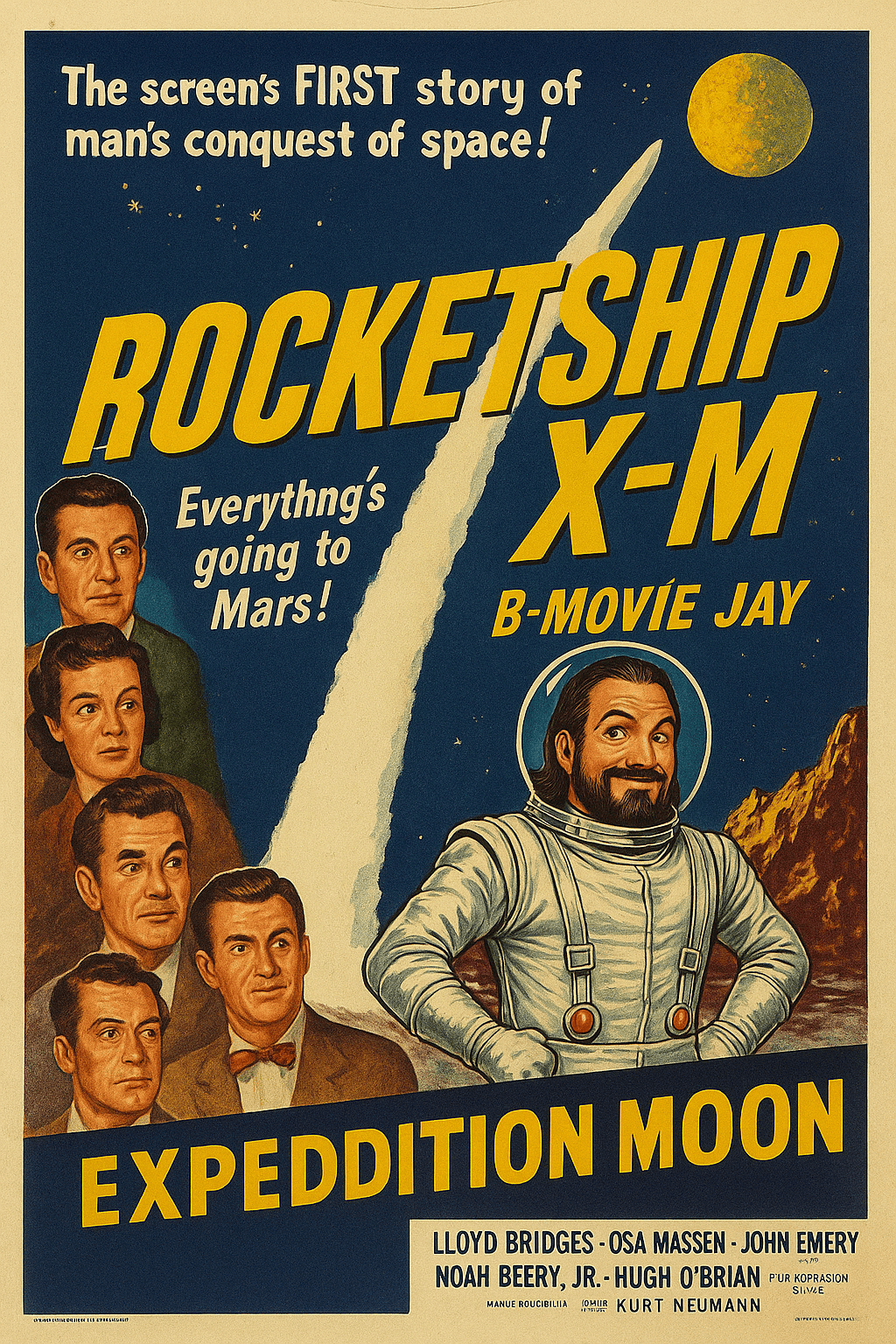
“They aimed for the Moon and woke up on Mars.”
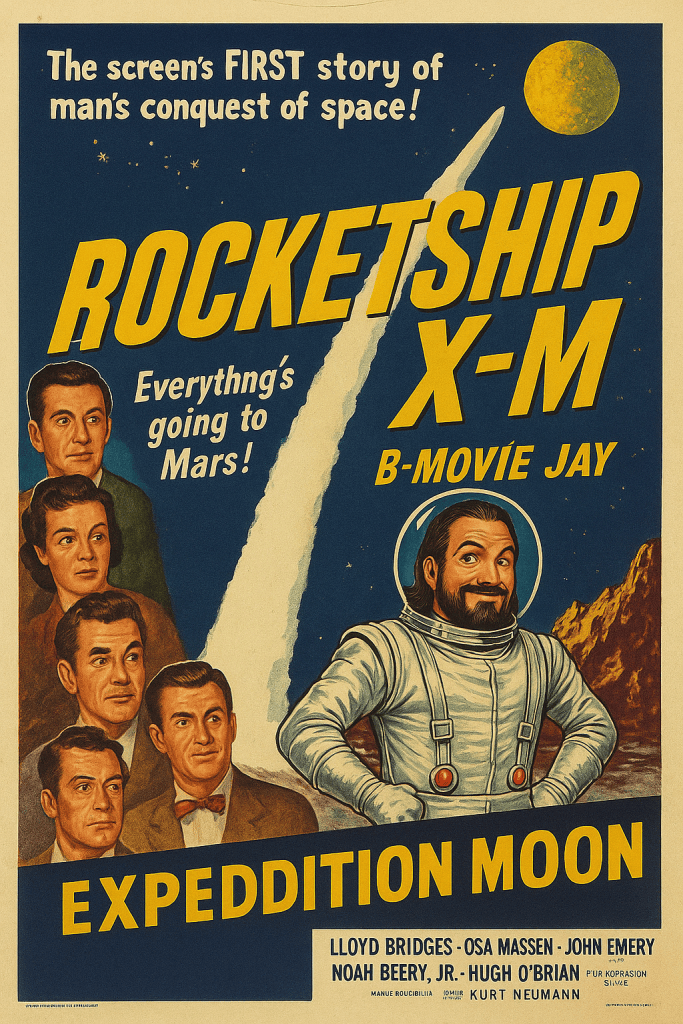
Why I Watched It
This was the film that tried to start it all. Released just before Destination Moon, Rocketship X-M wanted to bring serious science to the screen. Instead, it accidentally invented the “whoops, wrong planet” subgenre. I went in expecting early space-age wonder and came out with accidental romance, rogue harmonicas, and an atomic morality tale wearing a flight jacket.
Plot in 60 Seconds
A team of scientists prepares for the first flight to the Moon. With fifteen minutes left on the countdown, they hold a press conference, because nothing says “launch readiness” like a Q&A. Among them is Dr. Lisa Van Horn, a chemist asked what space travel feels like “from a woman’s point of view.”
Moments later they blast off in street clothes, stand upright through takeoff, and forget gravity exists until their instruments remind them. One engine tweak later, the crew blacks out for days and wakes up near Mars. Everyone agrees this is fine.
They land, discover a dead Martian civilization destroyed by nuclear war, and deliver the decade’s most earnest line: “What a lesson for our world.” The rocket then runs out of fuel, the crew crashes, and Earth immediately decides to build another one.
The Watch Experience
Watching Rocketship X-M feels like looking directly into the imagination of 1950. Space travel is portrayed as a slightly bumpy road trip. The crew strolls around the cabin, stares out the window, and treats Mars like a scenic detour. Gravity comes and goes as the plot requires.
The dialogue is equally adrift. Col. Floyd Graham, played by Lloyd Bridges, begins the mission with “What’s a girl like you doing in a place like this,” while Dr. Van Horn spends half the film apologizing for speaking. Dr. Karl Eckstrom, the resident physicist, announces that they will now be using “his calculations” because emotions are contagious.
Then comes the miracle of the meteorites. Imagine popcorn kernels flung at a porthole while someone offscreen shakes a tin tray. It is magnificent.
Yet beneath all of this, the movie means every word. When the crew finds evidence of nuclear self-destruction on Mars, the tone shifts from pulp to prophecy. For a film that launched with harmonicas and flirtation, it lands with surprising gravity.
Scene Stealers
Best Line:
Dr. Van Hornm weeping: “I’m sorry, Doctor.”
Dr. Eckstrom: “For what? For being a woman?”
Best Performance: Osa Massen as Dr. Van Horn, staying composed while the script keeps testing her patience.
Most Delightful Moment: The crew calmly deciding to land on Mars “since they’re already there.”
Behind the Reel
- Rushed into production to beat Destination Moon to theaters, it became the first serious postwar space feature.
- Director Kurt Neumann later made The Fly, which feels like karmic balance for what he put this cast through.
- Mars was tinted red through film processing, a clever trick that turned minimal sets into alien terrain.
- One of Lloyd Bridges’ earliest leading roles, filmed just as he was moving from character work into top billing. He’d dive back into adventure a few years later with Disney’s 20,000 Leagues Under the Sea (1954).
The 50-Foot Roll Call
Here’s the crew of this cosmic adventure, plus all of the other Watchlist films they appear in.
Director:
- Kurt Neumann – The Fly (1958)
Cast:
- Lloyd Bridges – Col. Floyd Graham
- Osa Massen – Dr. Lisa Van Horn
- John Emery – Dr. Karl Eckstrom – Kronos (1957)
- Noah Beery Jr. – Maj. William Corrigan
- Hugh O’Brian – Harry Chamberlain
- Morris Ankrum – Dr. Ralph Fleming – Invaders from Mars (1953), Earth vs. the Flying Saucers (1956), Kronos (1957), The Giant Claw (1957), Beginning of the End (1957), The Invisible Boy (1957), From the Earth to the Moon (1958)
Radiation Level
4.0 RADS (High Exposure)
Contains early symptoms of Cold War panic and mid-century sexism. Female expertise is met with suspicion, and physics is treated as an optional belief system.
Radiation Report: “Elevated readings of gender bias and scientific optimism. Proceed with humor and a lead apron.”
Does It Entertain?
It does, and it shouldn’t. The sincerity is contagious. The crew’s optimism, the clumsy romance, and the moral ending all work in spite of themselves. The final transmission from Mars is unseen but felt, and the somber “Tomorrow we begin construction of RX2” lands like a prayer disguised as bureaucracy.
Cheese Wedge Rating
🧀🧀🧀🧀 Four wedges for heart, history, and harmonica-based physics.
Final Thoughts
Rocketship X-M is the dream of spaceflight before NASA, before realism, before fear replaced wonder. It is both ridiculous and sincere, a pulp sermon about humanity’s urge to destroy itself.
By the end, the rocket has crashed, the crew is gone, and Earth is ready to try again. That quiet determination is what makes the film unforgettable. In the middle of its cardboard sets and moral lessons, it believes completely in the human spirit, even when it has no idea how rockets work.
Tags: 1950, Kurt Neumann, Lippert Pictures, Lloyd Bridges, Osa Massen, John Emery, Noah Beery Jr., Hugh O’Brian, Morris Ankrum, Atomic Age, Cold War Cinema, 1950s Sci-Fi, B-Movie Jay, Attack of the 50-Foot Watchlist




Leave a comment