The first film to feature a flying saucer… and maybe the least about one.
Why I Watched It
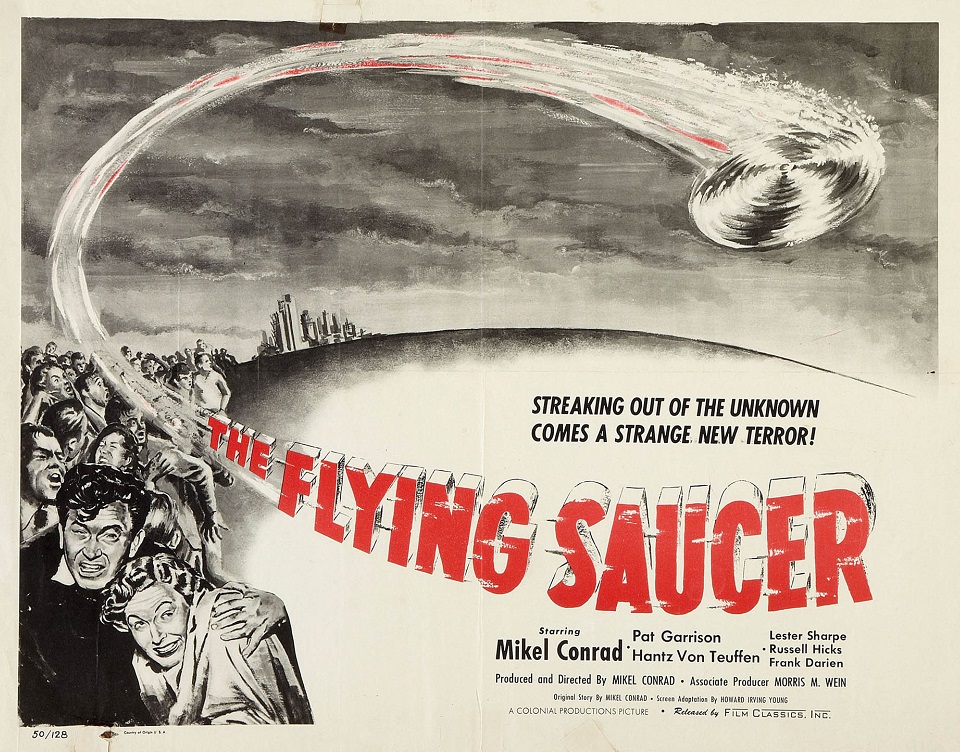
This one holds a strange but important little place in sci-fi history. The Flying Saucer (1950) is often credited as the very first feature film to actually include a flying saucer on screen, which automatically earns it a spot on the 50-Foot Watchlist. It’s not exactly a thrilling launch into the Atomic Age, but it’s a curious artifact, the kind of movie that captures a fleeting moment between postwar curiosity and Cold War paranoia.
I wanted to revisit it because it’s less a science fiction adventure and more a snapshot of early 1950s cultural imagination. It was filmed in Alaska, before it became a state, which gives it an almost travel-documentary quality. For all the talk of aliens and saucers, the real stars here are the mountains, glaciers, and wide-open skies. As both a sci-fi and culture fan, I find it fascinating how this film unintentionally documents a national mindset, one foot in postwar optimism and the other edging toward Cold War suspicion.
Plot in 60 Seconds
We meet Mike Trent, a playboy, sportsman, and part-time adventurer who’s apparently so cool that people constantly remind him of it…a lot. He’s hired to investigate rumors of a secret flying saucer in the wilds of Alaska, where he spends most of his time flying planes, flirting, and occasionally pretending to solve a mystery. Eventually, he stumbles upon the titular saucer which, unfortunately, only appears on screen about four times if you count takeoff and landing separately. Technically, yes, this movie has a flying saucer. Practically, it’s an Alaskan travelogue with an identity crisis.
The Watch Experience
Let’s be honest, this one’s a bit of a head-scratcher and doesn’t exactly keep you on the edge of your seat with action. Mikel Conrad wrote, directed, and starred in it, which means he got to play the charming rogue he clearly wished he was in real life. Unfortunately, that leaves about 95% of the film devoted to proving that point. There isn’t much “sci” in this sci-fi movie, but there’s plenty of fishing, flying, and flirting.
Even with its issues, the film has unexpected charm. The Alaskan scenery is just stunning, and it seems like the filmmakers knew it because the landscape totally steals the show from the story. A lot of the movie feels like someone’s personal vacation video, with tons of glacier flyovers and wide-angle shots of the wilderness from above. The sound really adds to it too, with engine noises fading in and out like the sound engineer was directing their own action scenes. More than once, I almost forgot what was happening, feeling like I was just watching an Alaskan Zenscape video instead.
And yet, I had fun watching it. The quirks, the pacing, even the sound design misfires all give it this charmingly unpolished feel. It’s the kind of movie you watch twice, once to see what it’s about, and again to confirm that it really happened the way you think it did.
Scene Stealers
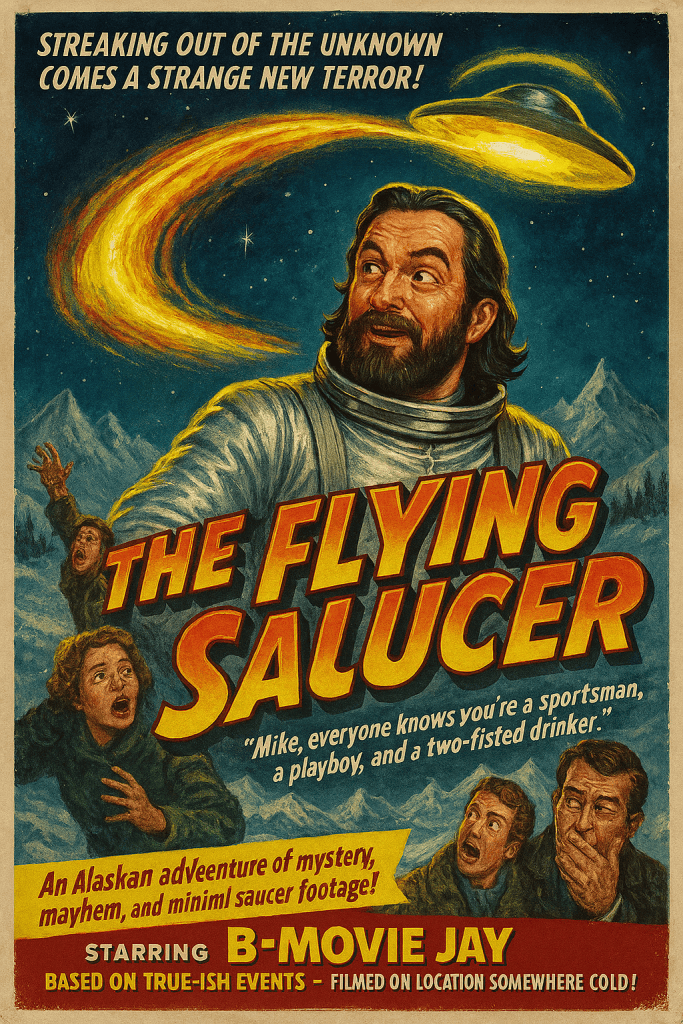
- Best Line: “Mike, everyone knows you’re a sportsman, a playboy, and a two-fisted drinker.” A line that tells you everything you need to know, mostly about the writer’s ego and one of my all-time favorites.
- Best Performance: The Alaskan wilderness, which clearly carried the movie.
- Most Delightful Moment: The scene where a plane seems to stall midair, complete with panic sound effects, while the pilot remains completely calm because, apparently, the plane never actually moves.
Behind the Reel
- Written, directed, and produced by Mikel Conrad, who also starred as the lead. Conrad also starred in several of my favorite Godzilla movies including Godzilla: King of the Monsters (1956) and Godzilla, the Monster of the Pacific Ocean (1957).
- Filmed on location in the Territory of Alaska (before it was made a state in 1959), giving it an unexpectedly documentary-like charm.
- Often cited as the first movie to feature a flying saucer on screen, even if it barely qualifies as science fiction.
Does It Entertain?
In its own accidental way, yes. It’s not fast-paced or full of spectacle, but it’s weirdly watchable. It’s part scenic travel film, part spy story, and part vanity project. There’s a sincerity to it that makes it fun, even when the pacing drags or the saucer budget clearly ran out. It’s less “alien invasion” and more “government intrigue with a side of glaciers,” but for fans of early sci-fi history, it’s essential viewing just to see where the genre began.
Cheese Wedge Rating
🧀🧀🧀
Uneven, earnest, and entertaining in all the wrong ways.
Final Thoughts
The Flying Saucer isn’t the best science fiction film of 1950 (not even close) but it’s a fascinating curio that marks the dawn of the saucer craze. It’s awkward, self-indulgent, and strangely beautiful at times, like a cinematic time capsule that didn’t quite know what it was supposed to be. Watch it for the history, stay for the sound effects, and enjoy the ride through early postwar imagination.




Leave a comment