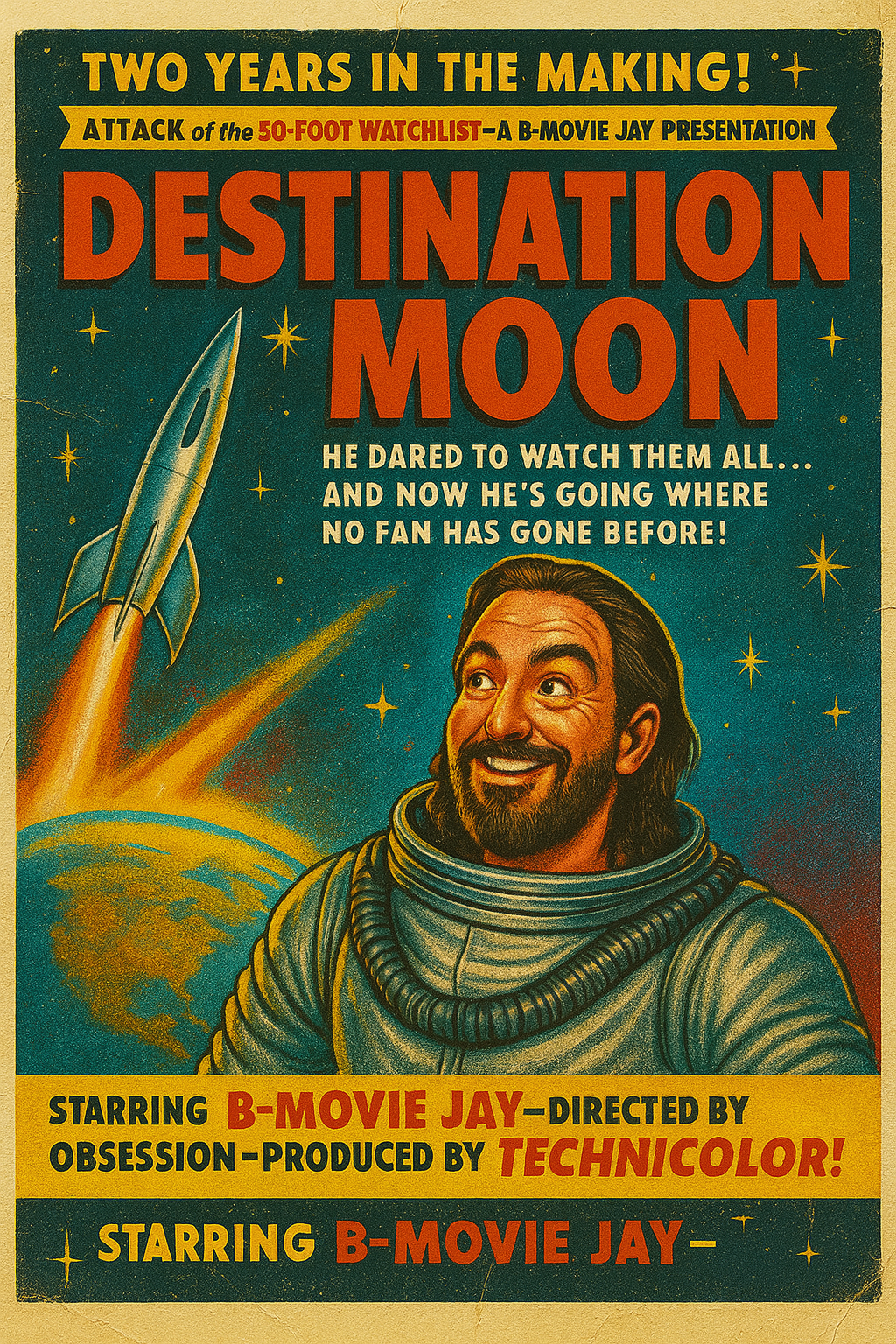
Tagline: When science took its first giant leap onto the silver screen.
Technicolor dreams, rocket fumes, and mid-century optimism! B-Movie Jay’s 50-Foot Watchlist presents the film that aimed for the stars and actually got there.
Why I Watched It
This one isn’t just important, it’s foundational. Destination Moon is the movie that really launched the 1950s sci-fi boom, setting the tone for everything that followed. Before the giant ants, mutant brains, and invading Martians showed up, this film looked to the stars and said, “Let’s go there.”
As someone who has always loved astronomy and space science, I can’t help but see this movie as a time capsule of imagination. It’s a window into an era when we hadn’t yet set foot beyond our own planet and when the moon was still a mysterious, unreachable world. As a cultural anthropologist, I find that fascinating. It captures a moment when humanity dreamed collectively, when we filled the void of the unknown with hope, wonder, and a little bit of science fiction magic.
We’ll never be that naive again. Today, we peer into galaxies millions of light years away and send robots to explore other worlds. The creative blank canvas that existed in 1950 is gone forever, replaced by data and discovery. Destination Moon gives us a glimpse of what it felt like to look up and truly not know what was waiting for us out there.
Before NASA, before Kubrick, there was this. A blast of 1950s optimism with just enough science to make you believe it might actually work.
Plot in 60 Seconds
When government red tape slows down America’s space program, a group of scientists and industrialists decide to take matters into their own hands. Their goal is to build a rocket, fly to the moon, and plant a flag before anyone else can. Along the way there are technical challenges, a little sabotage, and a lot of mid-century optimism. They eventually make the trip, land safely, and face a difficult choice about how to get back home when things don’t go exactly according to plan.
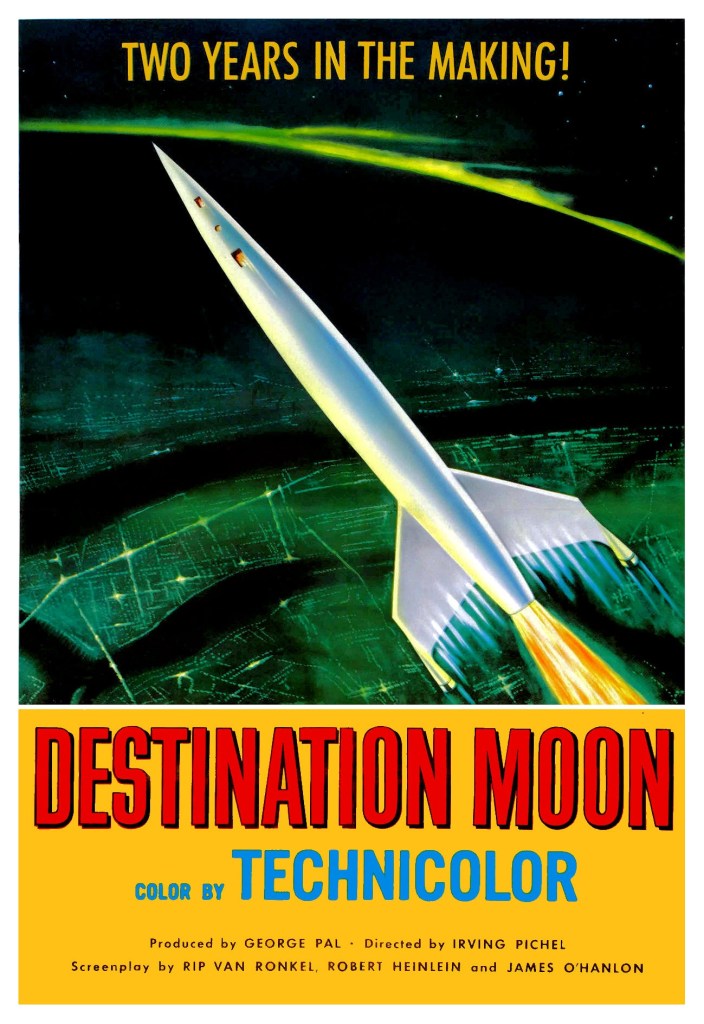
The poster that launched an era of cinematic space travel. Bold colors, big dreams, and a rocket aimed straight for history.
The Watch Experience
Watching Destination Moon feels like sitting in on a 1950s classroom filmstrip that someone accidentally gave a Hollywood budget. It’s a mix of education, adventure, and postwar pride, and it’s a fascinating time capsule of what people hoped the future would be. The story moves methodically, explaining every step of space travel like a patient teacher who really wants you to understand the math.
And somehow, it works. The attention to detail is impressive. The special effects are miles ahead of most early sci-fi, and the film even includes a short Woody Woodpecker cartoon to explain rocket propulsion. That moment alone might be one of the most delightfully strange things in any serious science fiction movie.
For something released in 1950, it gets a lot right about space flight. Zero gravity looks believable, inertia feels accurate, and the design of the rocket and suits looks surprisingly forward-thinking. But what really makes it work is its sincerity. The film genuinely believes in the promise of human progress, and that optimism is contagious.
Scene Stealers
Best Line: “It’s time for the American people to wake up.” The rallying cry of 1950s science fiction.
Best Performance: John Archer, who manages to keep a straight face while explaining orbital mechanics like it’s a backyard project.
Most Delightful Moment: The Woody Woodpecker cartoon that turns rocket science into Saturday morning fun.
Behind the Reel
- Based on Robert A. Heinlein’s 1947 novel Rocketship Galileo with screenplay input from Heinlein himself.
- Produced by George Pal, who later made When Worlds Collide and The War of the Worlds.
- Won the 1951 Academy Award for Best Special Effects, making it one of the first sci-fi films to be recognized that way.
Does It Entertain?
Yes, absolutely. It’s thoughtful, curious, and full of that early Cold War energy where science felt like the solution to everything. You won’t find monsters or melodrama here, but you will find imagination, sincerity, and a beautiful sense of possibility. It’s one of those films that makes you want to believe in humanity again, even when the dialogue starts sounding like a company training video.
Cheese Wedge Rating
🧀🧀🧀🧀
Visionary, ambitious, and delightfully sincere.
Final Thoughts
Destination Moon deserves its reputation as one of the most influential sci-fi films of the decade. It imagined space travel before most people even thought it was possible, and it did it with heart and conviction. This isn’t a movie about fear, it’s about faith in human ingenuity. It’s the film that pointed us toward the stars and said, “Someday, we’re really going to do this.”
Part of the 50-Foot Watchlist’s “Top Ten Must-Watch 1950s Sci-Fi” Collection
This film helped define the decade and launched an entire era of science fiction storytelling.
Tags: 1950, Space Exploration, George Pal, Robert A. Heinlein, Cold War Sci-Fi, Classic Technicolor, Top Ten




Leave a comment